

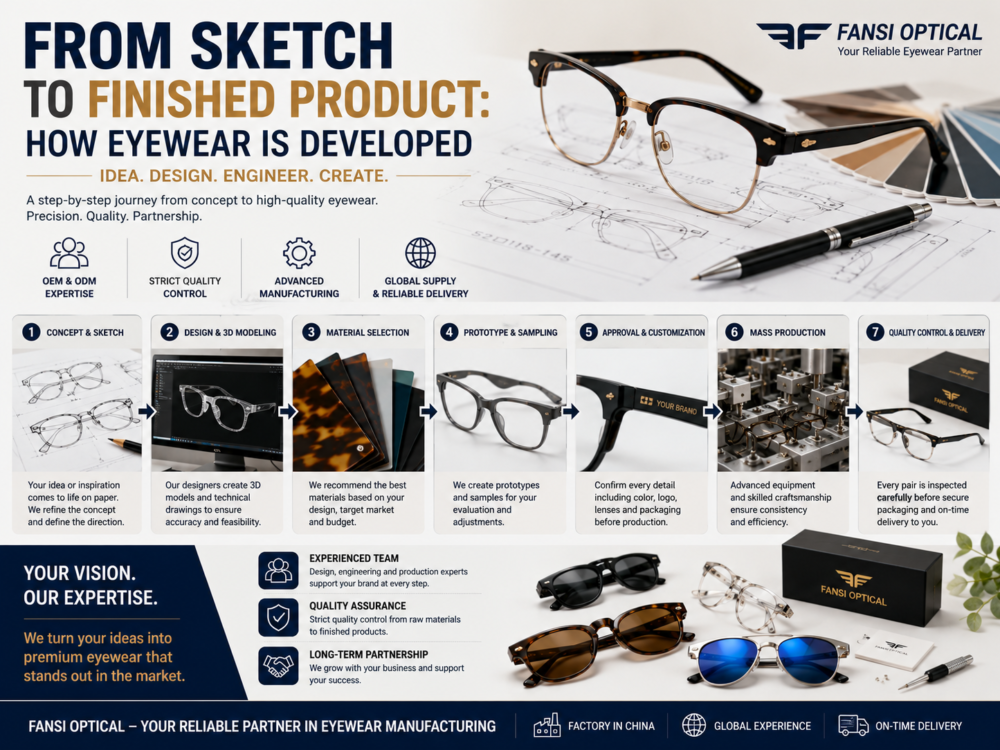
Every successful eyewear collection starts with an idea. It might be a hand-drawn sketch, a digital design, a reference frame, or a concept inspired by emerging fashion trends. However, turning that idea into a market-ready product requires much more than creating an attractive design.
For eyewear brands, importers, retailers, and distributors, understanding the eyewear development process is essential for controlling costs, maintaining quality, and bringing new products to market efficiently.
Working with an experienced custom eyewear manufacturer can help transform an initial concept into a finished product through a structured process that combines design, engineering, material selection, sampling, and manufacturing.
So, how does professional eyewear product development work?
1. Concept Development and Design
The first stage of eyewear development is defining the product concept.
Before manufacturing begins, brands need to identify their target customers, market positioning, price range, and design direction. A premium fashion brand may prioritize distinctive shapes and sophisticated finishes, while a sports eyewear collection may focus on lightweight construction, comfort, and performance.
The initial concept can be communicated through sketches, reference images, 3D drawings, or existing product samples.
At this stage, an experienced eyewear manufacturer can help evaluate whether the design is practical for production. Some frame shapes may require adjustments to improve fit, strength, comfort, or manufacturing efficiency.
Clear communication between the buyer and manufacturer at the beginning can reduce unnecessary revisions later.
2. Material Selection
Choosing the right material is one of the most important decisions in eyewear product development.
Different materials offer different advantages in appearance, weight, flexibility, durability, finishing, and cost.
Acetate is often selected for premium eyewear because of its rich colors, layered patterns, and polished appearance. TR90 is valued for its lightweight construction and flexibility, making it suitable for many everyday and sports-inspired designs. Metal frames can offer a refined appearance and slim profiles, while other materials may be appropriate for specialized product requirements.
For B2B buyers, material selection should reflect the intended customer, retail price, design requirements, and production quantity.
A knowledgeable eyewear supplier should explain the advantages and limitations of available materials rather than simply recommend the cheapest option.
3. Engineering and Technical Development
A design that looks attractive on paper must also work as a physical product.
During engineering development, the frame structure, dimensions, bridge design, temple length, hinge placement, lens shape, and other technical details are refined.
The manufacturer must consider how the frame will fit the wearer, accommodate the selected lenses, and maintain appropriate structural performance.
For customized projects, this stage may involve technical drawings, CAD files, 3D modeling, tooling preparation, or adjustments to existing frame structures.
An experienced OEM eyewear manufacturer can help identify potential manufacturing challenges before they become expensive problems during production.
The goal is to preserve the original design intent while making the product practical, comfortable, and suitable for consistent manufacturing.
4. Prototype and Sample Development
Once the design and technical specifications have been established, the next step is sample development.
The first sample allows the buyer to evaluate the actual frame shape, proportions, materials, colors, finishing, and overall appearance. Depending on the project, several rounds of sampling may be necessary.
The buyer may request adjustments to the frame width, temple shape, color, logo placement, hinge construction, or other details.
For private label and OEM projects, sample approval is particularly important because it establishes the reference for subsequent production.
A reliable custom eyewear manufacturer should communicate clearly during this stage, record approved specifications, and manage revisions carefully.
Taking sufficient time to evaluate samples can reduce the risk of costly changes after mass production has started.
5. Lens Selection and Product Customization
Eyewear development involves more than the frame itself. Lens specifications, branding, and packaging also influence the final product.
Depending on the product category, buyers may need to select polarized or non-polarized sunglass lenses, UV protection specifications, lens colors, optical lens requirements, or other functional features.
Brands can also customize frame colors, logos, temple details, packaging, labels, and accessories to create a distinctive collection.
This is where private label eyewear manufacturing provides significant value. Instead of selling generic products, businesses can develop eyewear that reflects their own brand identity and target market.
Before production, all important details should be confirmed, including color references, logo artwork, lens specifications, packaging requirements, and approved samples.
6. Mass Production and Quality Control
After the final sample and specifications are approved, the project can move into mass production.
Depending on the material and design, production may involve cutting, molding, shaping, polishing, assembly, lens installation, surface finishing, and other specialized processes.
Quality control should be integrated throughout production rather than left entirely until the final inspection.
Important checkpoints may include frame dimensions, alignment, hinge function, color consistency, surface finishing, lens installation, and overall assembly quality.
For international B2B buyers, consistent quality is especially important because defects can lead to customer complaints, returns, additional costs, and damage to brand reputation.
A professional eyewear manufacturer in China should establish clear product specifications and inspection requirements to help maintain consistency between approved samples and finished goods.
7. Packaging, Delivery, and Long-Term Support
The final stage includes packaging, order verification, shipment preparation, and delivery.
Packaging requirements may vary depending on the sales channel. An optical retailer may need protective cases and cleaning cloths, while a private label brand may require customized boxes, product labels, barcodes, and branded inserts.
Buyers should confirm packaging specifications, shipping arrangements, production schedules, and documentation requirements before the order is completed.
Reliable communication during this stage helps prevent misunderstandings and supports smoother international sourcing.
For growing eyewear brands, a manufacturing relationship should also extend beyond a single order. Future collections may require new colors, updated designs, additional sizes, or entirely new product categories.
OEM or ODM: Which Development Model Should You Choose?
The eyewear development process can be organized through different manufacturing models.
With OEM, the buyer typically provides its own design or detailed product requirements, and the manufacturer develops and produces the eyewear accordingly.
With ODM, the manufacturer offers existing designs or product concepts that can be customized for the buyer’s brand.
OEM is often suitable for brands seeking greater design control and differentiation. ODM can be a practical option for businesses looking to simplify development and introduce products more quickly.
An experienced OEM eyewear manufacturer or ODM eyewear supplier should help buyers understand which approach best fits their budget, design resources, and business objectives.
Choosing the Right Eyewear Manufacturing Partner
Developing eyewear successfully requires cooperation between design, engineering, production, and quality control.
The right manufacturing partner should understand your product concept, provide practical technical advice, support sample development, and maintain consistent quality during mass production.
At FANSI OPTICAL, we work with international eyewear brands, importers, retailers, and distributors to develop and manufacture eyewear through OEM and ODM solutions.
Whether you are starting with a simple sketch, refining an existing design, or planning a complete private label collection, a structured development process can help turn your ideas into finished products.
Looking for a reliable custom eyewear manufacturer for your next collection? Contact FANSI OPTICAL to discuss your design, material, and manufacturing requirements.